
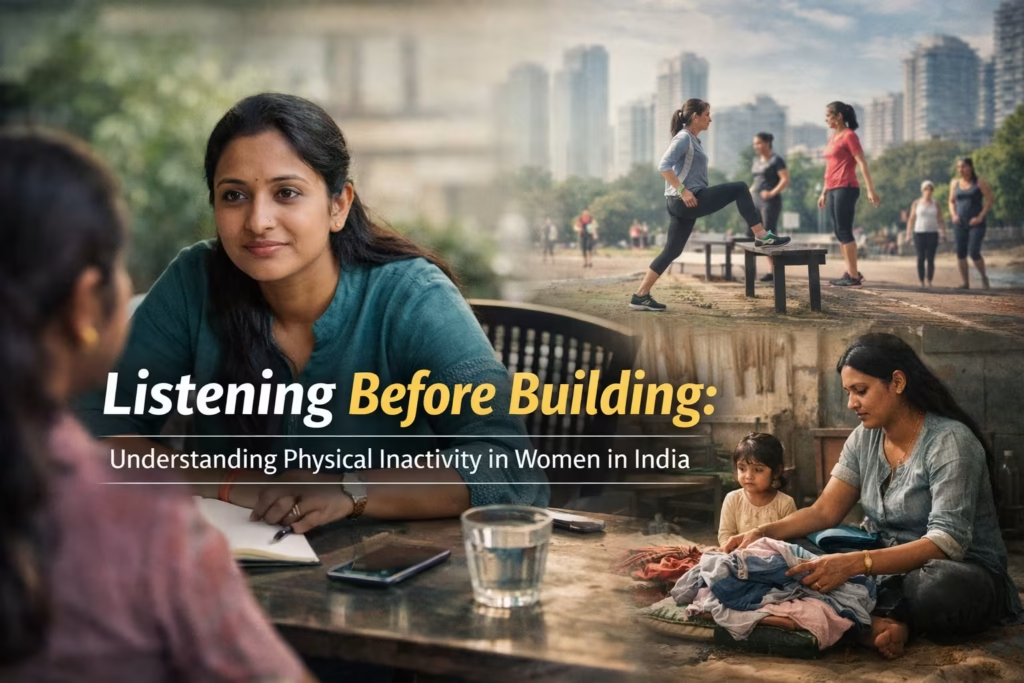
Across this series, we have examined multiple dimensions of physical inactivity in women in India and the broader patterns shaping participation.
We began with the global 150-minute benchmark and what public data suggests about activity levels.
Understanding the 150-Minute Benchmark
We explored women’s physical activity barriers, including structural and everyday constraints.
Why Many Women Struggle to Meet Guidelines
We clarified definitions around exercise, moderate intensity, and how physical activity is measured.
We also examined the systemic and economic implications of inactivity.
Women’s Physical Activity and Economic Growth
What becomes clear is this:
What remains less visible is how lived experience shapes physical inactivity in women in India in daily life.
Entrepreneurial culture often rewards speed.
Identify a problem.
Design a solution.
Launch quickly.
However, challenges such as physical inactivity in women in India are not simple problems.
They are shaped by:
This is not a technology problem or an awareness gap alone.
When participation remains low despite available information, the issue is deeper than knowledge.
Building too quickly risks misunderstanding the problem itself.
Public data gives direction.
It shows that:
However, data does not capture:
Quantitative insights show patterns.
Qualitative insights explain behavior.
Understanding women physical activity barriers requires both.
Listening is often treated as a soft skill.
In reality, it is foundational infrastructure.
A listening approach to health interventions helps:
Listening does not solve the problem directly.
But it prevents solving the wrong problem.
It is easy to assume:
These assumptions oversimplify physical inactivity in women in India.
If time alone were the issue, flexible schedules would solve it.
If awareness were enough, education campaigns would work.
Yet the gap persists.
This indicates layered, interconnected factors influencing women fitness participation in India.
Physical activity is not a one-time decision. It is a habit.
Behavior change in physical activity depends on:
Sustainable change is rarely triggered by motivation alone.
It requires systems that support consistency.
At this stage, the goal is not to build solutions.
It is to begin structured listening.
This may include:
The objective is clarity, not validation.
Public health issues often create pressure to act quickly.
But speed without understanding leads to shallow outcomes.
Physical inactivity in women in India intersects with:
Responsible engagement requires:
When real experiences are understood:
But these outcomes require proximity to reality.
They cannot be designed from distance.
According to the World Health Organization, insufficient physical activity remains one of the leading risk factors for global mortality.
Because complex behavioral problems like physical inactivity in women in India require deeper understanding to avoid ineffective solutions.
No. But it is a necessary foundation for designing meaningful interventions.
It reveals real constraints, enabling better alignment between solutions and lived realities.
It may extend timelines but improves long-term effectiveness.
This series is an effort to better understand women’s physical activity patterns in India.
Public data shows the gap.
Lived experience explains it.
If you would like to participate in structured discussions or listening circles, you may indicate your interest below.
Physical inactivity in women in India is not just a personal issue.
It connects to:
The 150-minute benchmark provides a measurable baseline.
Understanding the 150-Minute Benchmark
Understanding why that baseline is unmet requires deeper work.
Before building, listening.
Before assuming, observing.
Before intervening, understanding.

